Monday, January 20, 2020

Playfair Cipher

In this scheme, pairs of letters are encrypted, instead of single letters as in the case of simple substitution cipher.
In playfair cipher, initially a key table is created. The key table is a 5×5 grid of alphabets that acts as the key for encrypting the plaintext. Each of the 25 alphabets must be unique and one letter of the alphabet (usually J) is omitted from the table as we need only 25 alphabets instead of 26. If the plaintext contains J, then it is replaced by I.
The sender and the receiver deicide on a particular key, say ‘tutorials’. In a key table, the first characters (going left to right) in the table is the phrase, excluding the duplicate letters. The rest of the table will be filled with the remaining letters of the alphabet, in natural order. The key table works out to be −
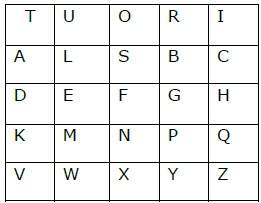
Key Table

Process of Playfair Cipher

  • First, a plaintext message is split into pairs of two letters (digraphs). If there is an odd number of letters, a Z is added to the last letter. Let us say we want to encrypt the message “hide money”. It will be written as −
    HI DE MO NE YZ
  • The rules of encryption are −
    • If both the letters are in the same column, take the letter below each one (going back to the top if at the bottom)
  • TUORI‘H’ and ‘I’ are in same column, hence take letter below them to replace. HI → QC
    ALSBC
    DEFGH
    KMNPQ
    VWXYZ
  • If both letters are in the same row, take the letter to the right of each one (going back to the left if at the farthest right)
  • TUORI‘D’ and ‘E’ are in same row, hence take letter to the right of them to replace. DE → EF
    ALSBC
    DEFGH
    KMNPQ
    VWXYZ
  • If neither of the preceding two rules are true, form a rectangle with the two letters and take the letters on the horizontal opposite corner of the rectangle.
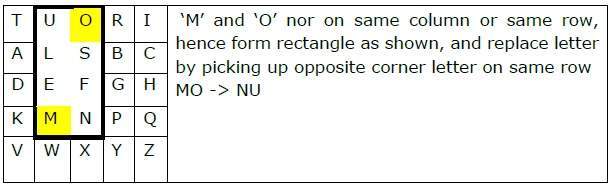
Playfair Cipher
Using these rules, the result of the encryption of ‘hide money’ with the key of ‘tutorials’ would be −
QC EF NU MF ZV
Decrypting the Playfair cipher is as simple as doing the same process in reverse. Receiver has the same key and can create the same key table, and then decrypt any messages made using that key.

Sunday, January 19, 2020

IDEA (International Data Encryption Algorithm)

IDEA, unlike the other block cipher algorithms discussed in this section, is patented by the Swiss firm of Ascom. They have, however, been generous in allowing, with permission, free noncommercial use of their algorithm, with the result that IDEA is best known as the block cipher algorithm used within the popular encryption program PGP.
The IDEA algorithm is interesting in its own right. It includes some steps which, at first, make it appear that it might be a non-invertible hash function instead of a block cipher. Also, it is interesting in that it entirely avoids the use of any lookup tables or S-boxes.
IDEA uses 52 subkeys, each 16 bits long. Two are used during each round proper, and four are used before every round and after the last round. It has eight rounds.
The plaintext block in IDEA is divided into four quarters, each 16 bits long. Three operations are used in IDEA to combine two 16 bit values to produce a 16 bit result, addition, XOR, and multiplication. Addition is normal addition with carries, modulo 65,536. Multiplication, as used in IDEA, requires some explanation.
Multiplication by zero always produces zero, and is not invertible. Multiplication modulo n is also not invertible whenever it is by a number which is not relatively prime to n. The way multiplication is used in IDEA, it is necessary that it be always invertible. This is true of multiplication IDEA style.
The number 65,537, which is 2^16+1, is a prime number. (Incidentally, 2^8+1, or 257, is also prime, and so is 2^4+1, or 17, but 2^32+1 is not prime, so IDEA cannot be trivially scaled up to a 128-bit block size.) Thus, if one forms a multiplication table for the numbers from 1 through 65,536, each row and column will contain every number once only, forming a Latin square, and providing an invertible operation. The numbers that 16 bits normally represent are from 0 to 65,535 (or, perhaps even more commonly, from -32,768 to 32,767). In IDEA, for purposes of multiplication, a 16 bit word containing all zeroes is considered to represent the number 65,536; other numbers are represented in conventional unsigned notation, and multiplication is modulo the prime number 65,537.

Description of IDEA

Let the four quarters of the plaintext be called A, B, C, and D, and the 52 subkeys called K(1) through K(52).
Before round 1, or as the first part of it, the following is done:
Multiply A by K(1). Add K(2) to B. Add K(3) to C. Multiply D by K(4).
Round 1 proper consists of the following:
Calculate A xor C (call it E) and B xor D (call it F).
Multiply E by K(5). Add the new value of E to F.
Multiply the new value of F by K(6). Add the result, which is also the new value of F, to E.
Change both A and C by XORing the current value of F with each of them; change both B and D by XORing the current value of E with each of them.
Swap B and C.
Repeat all of this eight times, or seven more times, using K(7) through K(12) the second time, up to K(43) through K(48) the eighth time. Note that the swap of B and C is not performed after round 8.
Then multiply A by K(49). Add K(50) to B. Add K(51) to C. Multiply D by K(52).
The intricacies of IDEA encryption may be made somewhat clearer by examining the following diagrams:
Details:  Overview: 

Decryption

How can the round in IDEA be reversed, since all four quarters of the block are changed at the same time, based on a function of all four of their old values? Well, the trick to that is that A xor C isn't changed when both A and C are XORed by the same value, that value cancels out, no matter what that value might be. And the same applies to B xor D. And since the values used are functions of (A xor C) and (B xor D), they are still available.
This cross-footed round, rather than a Feistel round, is the most striking distinguishing factor of IDEA, although its use of multiplication, addition, and XOR to avoid the use of S-boxes is also important.

Friday, January 17, 2020

The Blowfish Encryption Algorithm

  • Block cipher: 64-bit block
  • Variable key length: 32 bits to 448 bits
  • Designed by Bruce Schneier
  • Much faster than DES and IDEA
  • Unpatented and royalty-free
  • No license required
Blowfish is a symmetric block cipher that can be used as a drop-in replacement for DES or IDEA. It takes a variable-length key, from 32 bits to 448 bits, making it ideal for both domestic and exportable use. Blowfish was designed in 1993 by Bruce Schneier as a fast, free alternative to existing encryption algorithms. Since then it has been analyzed considerably, and it is slowly gaining acceptance as a strong encryption algorithm. Blowfish is unpatented and license-free, and is available free for all uses.


A graphical representation of the Blowfish algorithm appears in Figure 1. In this description, a 64-bit plaintext message is first divided into 32 bits. The “left” 32 bits are XORed with the first element of a P-array to create a value I'll call P', run through a transformation function called F, then XORed with the “right” 32 bits of the message to produce a new value I'll call F'. F' then replaces the “left” half of the message and P' replaces the “right” half, and the process is repeated 15 more times with successive members of the P-array. The resulting P' and F' are then XORed with the last two entries in the P-array (entries 17 and 18), and recombined to produce the 64-bit ciphertext.
Figure 2: Graphic representation of F