Showing posts with label Authentication Requirements. Show all posts

Monday, February 3, 2020

Cryptography Hash functions

Hash functions are extremely useful and appear in almost all information security applications.
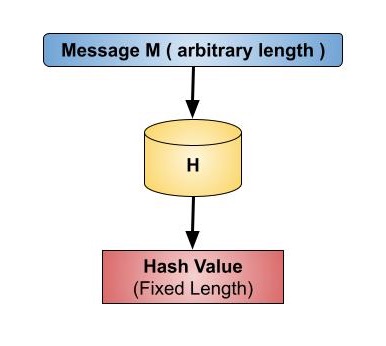
A hash function is a mathematical function that converts a numerical input value into another compressed numerical value. The input to the hash function is of arbitrary length but output is always of fixed length.
Values returned by a hash function are called message digest or simply hash values. The following picture illustrated hash function −
Hash Functions

Features of Hash Functions

The typical features of hash functions are −
  • Fixed Length Output (Hash Value)
    • Hash function coverts data of arbitrary length to a fixed length. This process is often referred to as hashing the data.
    • In general, the hash is much smaller than the input data, hence hash functions are sometimes called compression functions.
    • Since a hash is a smaller representation of a larger data, it is also referred to as a digest.
    • Hash function with n bit output is referred to as an n-bit hash function. Popular hash functions generate values between 160 and 512 bits.
  • Efficiency of Operation
    • Generally for any hash function h with input x, computation of h(x) is a fast operation.
    • Computationally hash functions are much faster than a symmetric encryption.

Wednesday, December 11, 2019

Cryptography and Network Security

Authentication Requirements
In the context of communications across a network, the following attacks can be identified:
1. Disclosure: Release of message contents to any person or process not possessing the appropriate cryptographic key.
2. Traffic analysis: Discovery of the pattern of traffic between parties. In a connection oriented application, the frequency and duration of connections could be determined. In either a connection-oriented or connectionless environment, the number and length of messages between parties could be determined.
3. Masquerade: Insertion of messages into the network from a fraudulent source. This includes the creation of messages by an opponent that are purported to come from an authorized entity. Also included are fraudulent acknowledgments of message receipt or nonreceipt by someone other than the message recipient.
4. Content Modification: Changes to the contents of a message, including insertion, deletion, transposition, or modification.
5. Sequence modification: Any modification to a sequence of messages between parties, including insertion, deletion, and reordering.
6. Timing modification: Delay or replay of messages. In a connection-orientated application, an entire session or sequence of messages could be a replay of some previous valid session, or individual messages in the sequence could be delayed or replayed.
7. Repudiation: Denial of receipt of message by destination or denial of transmission of message by source.
Message authentication is a procedure to verify that received messages come from the alleged source and have not been altered. Message authentication may also verify sequencing and timeliness. A digital signature is an authentication technique that also includes measures to counter repudiation by either source or destination.
Any message authentication or digital signature mechanism can be viewed as having fundamentally two levels. At the lower level, there must be some sort of function that produces an authenticator: a value to be used to authenticate a message. This lowerlevel function is then used as primitive in a higher-level authentication protocol that enables a receiver to verify the authenticity of a message.