RSA is just one way of doing public key encryption. Knapsack is a good alternative where we can create a public key and a private one. The knapsack problem defines a problem where we have a number of weights and then must pack our knapsack with the minimum number of weights that will make it a given weight. In general the problem is:
- Given a set of numbers A and a number b.
- Find a subset of A which sums to b (or gets nearest to it).
So imagine you have a set of weights of 1, 4, 6, 8 and 15, and we want to get a weight of 28, we could thus use 1, 4, 8 and 15 (1+4+8+15=28).
So our code would become 11011 (represented by '1', '4', no '6', '8' and '15'.
Then if our plain text is 10011, with a knapsack of 1, 4, 6, 8, 15, we have a cipher text of 1+4+8+15 which gives us 28.
A plain text of 00001 will give us a cipher text of 15.
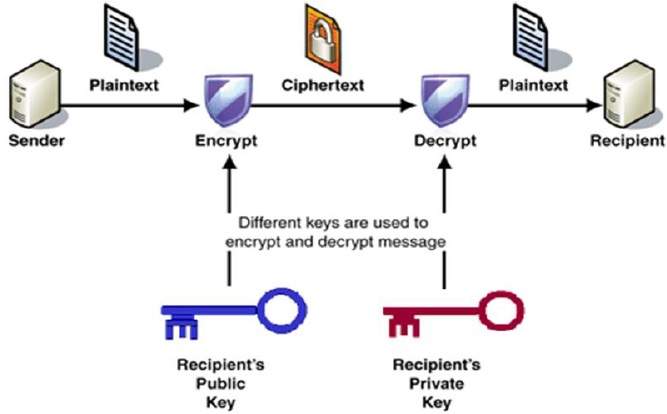
With public key cryptography we have two knapsack problems. One of which is easy to solve (private key), and the other difficult (public key).
Creating a public and a private key
We can now create a super-increasing sequence with our weights where the cur-rent value is greater than the sum of the preceding ones, such as {1, 2, 4, 9, 20, 38}. Super-increasing sequences make it easy to solve the knapsack problem, where we take the total weight, and compare it with the largest weight, if it is greater than the weight, it is in it, otherwise it is not.
For example with weights of {1,2,4,9,20,38} with a value of 54, we get:
Check 54 for 38? Yes (smaller than 54). [1] We now have a balance of 16.Check 16 for 20? No. [0].Check 5 for 4? Yes. [1]. We now have a balance of 1.Check 16 for 9? Yes. [1]. We now have a balance of 5. Check 1 for 2? No. [0].Check 1 for 1? Yes [1].
Our result is 101101.
If we have a non-super-increasing knapsack such as {1,3,4,6,10,12,41}, and have to make 54, it is much more difficult. So a non-super-increasing knapsack can be the public key, and the super-increasing one is the private key.
Making the Public Key
We first start with our super-increasing sequence, such as {1,2,4,10,20,40} and take the values and multiply by a number n, and take a modulus (m) of a value which is greater than the total (m - such as 120). For n we make sure that there are no common factors with any of the numbers. Let's select an n value of 53, so we get:
1×53 mod(120) = 532×53 mod(120) = 1064×53 mod(120) = 9220×53 mod(120) = 10010×53 mod(120) = 5040×53 mod(120) = 80
So the public key is: {53,106,92,50,100,80} and the private key is {1, 2, 4, 10, 20,40}. The public key will be difficult to factor while the private key will be easy. Let's try to send a message that is in binary code:
111010 101101 111001
We have six weights so we split into three groups of six weights:
111010 = 53 + 106 + 92 + 100 = 351101101 = 53+ 92 + 50 + 80 = 275111001 = 53 + 106 + 92 + 80 = 331
Our cipher text is thus 351 275 331.
The two numbers known by the receiver is thus 120 (m - modulus) and 53 (n multiplier).
We need n-1, which is a multiplicative inverse of n mod m, i.e. n(n−1) = 1 mod m. For this we find the inverse of n:
n-1 = 53-1 mod 120(53 x _n) mod 120 = 1
So we try values of n-1 in (53 x n-1 mod 120) in order to get a result of 1:
n-1 Result1 533 392 106 ...77 175 1576 68
The inverse of 53 mod 120 is 77
Working out (we are searching for a value of 1)
Val (val * n) mod m
1 53
2 106
3 39
4 92
5 25
6 78
7 11
8 64
9 117
10 50
11 103
12 36
13 89
14 22
15 75
16 8
17 61
18 114
19 47
20 100
21 33
22 86
23 19
24 72
25 5
26 58
27 111
28 44
29 97
30 30
31 83
32 16
33 69
34 2
35 55
36 108
37 41
38 94
39 27
40 80
41 13
42 66
43 119
44 52
45 105
46 38
47 91
48 24
49 77
50 10
51 63
52 116
53 49
54 102
55 35
56 88
57 21
58 74
59 7
60 60
61 113
62 46
63 99
64 32
65 85
66 18
67 71
68 4
69 57
70 110
71 43
72 96
73 29
74 82
75 15
76 68
77 1
Found it at 77