Monday, February 3, 2020

SECURE HASH ALGORITHM - SHA 512

Hashing Algorithm — SHA-512

So, SHA-512 does its work in a few stages. These stages go as follows:
  1. Input formatting
  2. Hash buffer initialization
  3. Message Processing
  4. Output
Let’s look at these one-by-one.
  1. Input Formatting:
SHA-512 can’t actually hash a message input of any size, i.e. it has an input size limit. This limit is imposed by its very structure as you may see further on. The entire formatted mesage has basically three parts: the original message, padding bits, size of original message. And this should all have a combined size of a whole multiple of 1024 bits. This is because the formatted message will be processed as blocks of 1024 bits each, so each bock should have 1024 bits to work with.
<pic: original message>
Original message
Padding bits
The input message is taken and some padding bits are appended to it in order to get it to the desired length. The bits that are used for padding are simply ‘0’ bits with a leading ‘1’ (100000…000). Also, according to the algorithm, padding needs to be done, even if it is by one bit. So a single padding bit would only be a ‘1’.
The total size should be equal to 128 bits short of a multiple of 1024 since the goal is to have the formatted message size as a multiple of 1024 bits (N x 1024).
<pic: msg + pad>
Message with padding
Padding size
After this, the size of the original message given to the algorithm is appended. This size value needs to be represented in 128 bits and is the only reason that the SHA-512 has a limitation for its input message.
Since the size of the original message needs to be represented in 128 bits, the message size can be at most (2¹²⁹-1) bits and also taking into consideration the necessary single padding bit, it maximum size would then be (2¹²⁹-2). Even though this limit exists, it doesn’t actually cause a problem since the actual limit is so high (2¹²⁹-2 = 680,564,733,841,876,926,926,749,214,863,536,422,910 bits).
<pic: msg + pad +size>
Message with padding and size
Now that the padding bits and the size of the message have been appended, we are left with the completely formatted input for the SHA-512 algorithm.
Formatted Message
2. Hash buffer initialization:
The algorithm works in a way where it processes each block of 1024 bits from the message using the result from the previous block. Now, this poses a problem for the first 1024 bit block which can’t use the result from any previous processing. This problem can be solved by using a default value to be used for the first block in order to start off the process. (Have a look at the second-last diagram).
Since each intermediate result needs to be used in processing the next block, it needs to be stored somewhere for later use. This would be done by the hash buffer, this would also then hold the final hash digest of the entire processing phase of SHA-512 as the last of these ‘intermediate’ results.
So, the default values used for starting off the chain processing of each 1024 bit block are also stored into the hash buffer at the start of processing. The actual value used is of little consequence, but for those interested, the values used are obtained by taking the first 64 bits of the fractional parts of the square roots of the first 8 prime numbers (2,3,5,7,11,13,17,19). These values are called the Initial Vectors (IV).
Why 8 prime numbers instead of 9? Because the hash buffer actually consists of 8 subparts (registers) for storing them.
<pic: IV>
Hash buffer and Initialization Vector values

Cryptography Hash functions

Hash functions are extremely useful and appear in almost all information security applications.
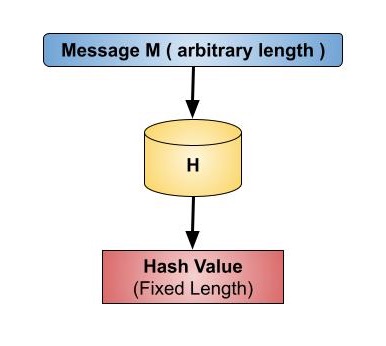
A hash function is a mathematical function that converts a numerical input value into another compressed numerical value. The input to the hash function is of arbitrary length but output is always of fixed length.
Values returned by a hash function are called message digest or simply hash values. The following picture illustrated hash function −
Hash Functions

Features of Hash Functions

The typical features of hash functions are −
  • Fixed Length Output (Hash Value)
    • Hash function coverts data of arbitrary length to a fixed length. This process is often referred to as hashing the data.
    • In general, the hash is much smaller than the input data, hence hash functions are sometimes called compression functions.
    • Since a hash is a smaller representation of a larger data, it is also referred to as a digest.
    • Hash function with n bit output is referred to as an n-bit hash function. Popular hash functions generate values between 160 and 512 bits.
  • Efficiency of Operation
    • Generally for any hash function h with input x, computation of h(x) is a fast operation.
    • Computationally hash functions are much faster than a symmetric encryption.

Friday, January 31, 2020

MESSAGE AUTHENTICATION REQUIREMENTS

In the context of communications across a network, the following attacks can be identified.
1.                                       Disclosure: Release of message contents to any person or process not possess- ing the appropriate cryptographic key.
2.                                       TraffianalysisDiscovery of the pattern of traffic between parties. In a connection-oriented application, the frequency and duration of connections could be determined. In either a connection-oriented or connectionless environ- ment, the number and length of messages between parties could be determined.
3.                                       Masquerade: Insertion of messages into the network from a fraudulent source. This includes the creation of messages by an opponent that are purported to come from an authorized entity. Also included are fraudulent acknowledg- ments of message receipt or nonreceipt by someone other than the message recipient.
4.                                       Content modification: Changes to the contents of a message, including insertion, deletion, transposition, and modification.
5.                                       Sequence modification: Any modification to a sequence of messages between parties, including insertion, deletion, and reordering.
6.                                       Timing modification: Delay or replay of messages. In a connection-oriented application, an entire session or sequence of messages could be a replay of some previous valid session, or individual messages in the sequence could be delayed or replayed. In a connectionless application, an individual message (e.g., data- gram) could be delayed or replayed.
7.                                       Source repudiation: Denial of transmission of message by source.
8.                                       Destination repudiation: Denial of receipt of message by destination.
Measures to deal with the first two attacks are in the realm of message confi- dentiality and are dealt with in Part One. Measures to deal with items (3)  through
(2)                             in the foregoing list are generally regarded as message authentication. Mechanisms for dealing specifically with item (7) come under the heading of digital signatures. Generally, a digital signature technique will also counter some or all of the attacks listed under items (3) through (6). Dealing with item (8) may require a combination of the use of digital signatures and a protocol designed to counter this attack.
In summary, message authentication is a procedure to verify that received messages come from the alleged source and have not been altered. Message authentication may also verify sequencing and timeliness. A digital signature is an authentication technique that also includes measures to counter repudiation by the source.